Most decks we build in the Rochester area land between $9,000 and $30,000 installed, with material, size, and elevation driving the spread. A small pressure-treated deck off a single-story home sits at the low end. A mid-large size capped composite build with custom railings, stairs, and lighting sits at the high end. The numbers below break down what you pay for, why the range is wide, and how to budget for a deck that holds up to Rochester winters for the next 20 to 30 years.
What Drives Deck Cost in Rochester
Seven factors decide where your deck lands inside that range:
Material. The single biggest cost lever. Pressure-treated is the most cost effective. Composite roughly doubles to triples the per-foot cost of pressure-treated, depending on the board line.
Size. Square footage scales the material and labor budget proportionally, but smaller decks carry a higher cost per square foot because fixed costs (permits, mobilization, footings) spread across less area.
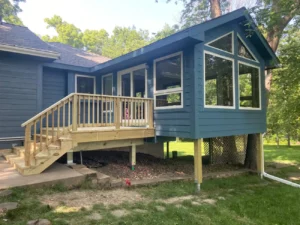
Elevation. A ground-level deck off a walkout is the cheapest scenario. A second-story deck off a sliding door needs taller posts, longer stringer stairs, and code-required guardrails, all of which add framing labor and material.
Railings. Pressure-treated wood railing is the least expensive. Aluminum or composite railing runs higher. Cable rail and glass panel systems carry the highest upcharge per linear foot.
Demo of existing deck. If we are tearing down and hauling away an old deck before building the new one, that adds labor and dump fees. Pouring fresh footings on a clean site is the cheapest scenario.
Permits and inspections. Most Monroe County towns require a building permit for any deck attached to the house. Permit cost varies by town. See our Rochester deck permits guide for the breakdown.
Custom features. Built-in benches, planters, inset lighting, multi-level platforms, pergolas, and privacy walls all add line items. Useful upgrades, but each one moves the total.
Deck Cost by Material in Rochester
Material is the largest single variable. Here is what each option runs installed in the Rochester market, and what a typical 300-square-foot deck (a common mid-size build) costs in each.
Pressure-treated
$20 to $40 per square foot installed. 300-sqft deck: $7,500 to $12,000 before add-ons.
The most affordable framing-and-decking option, and still the most common choice for budget-conscious builds. Pressure-treated lumber is rated for ground contact and resists insect damage. It needs annual cleaning and a fresh sealer or stain every two to three years to keep its color. Expect 15 to 20 years of life with regular maintenance. What pushes the price toward the upper end: railing upgrades, stairs, and access challenges.
Composite (Trex, TimberTech, AZEK)
$35 to $75 per square foot installed. 300-sqft deck: $10,500 to $22,000 before add-ons.
Composite boards are wood-fiber composite with a hard polymer cap on the top and sides, and the higher lines (like AZEK) run fully PVC with no wood fiber at all. No annual sealing. No splinters. Color holds for 25 plus years with a wash-down once or twice a year, and most boards carry 25 to 50 year limited warranties. The range comes from the board line you pick: entry-level capped composite at the low end, premium PVC and deep-grain styles with the closest visual match to real hardwood at the top. Style and color choices are wide. This is the choice for homeowners who want the deck to look the same in year 15 as it did in year 1, with no weekend maintenance.
Every range above is for the deck surface and basic railing. Stairs, multi-level builds, custom rail systems, and lighting move the total. See the example builds further down to put the numbers in context, or browse our deck builder in Rochester NY page for project photos at each material tier.
Deck Cost by Size in Rochester
Size sets the budget, but the per-foot cost shifts depending on how much deck you are building. Fixed costs (footings, permits, mobilization) spread better across larger projects. Here is what to expect across the four common size brackets we build.
| Size | Pressure-treated | Composite |
|---|---|---|
| Small (under 200 sqft) | $5,000 to $10,000 | $12,000 to $22,000 |
| Mid (200 to 400 sqft) | $7,500 to $17,500 | $16,000 to $28,000 |
| Large (400 to 600 sqft) | $15,000 to $25,000 | $20,000 to $42,000 |
| Premium (600+ sqft) | $15,500+ | $32,000+ |
These ranges assume a single-level deck at standard elevation with basic matching railing. Multi-level builds, second-story decks with stairs, and custom railing upgrades push toward the high end of each cell or beyond. For ideas at any size, our deck design ideas page shows what is possible at each tier.
Hidden Costs Rochester Homeowners Often Miss
When homeowners compare quotes, the surprises usually live in the line items below. A complete quote covers them. A thin quote leaves them off and surfaces them as change orders later.
Permits. Most Monroe County towns require a building permit for any attached deck. Fees range from about $75 to $300 depending on town and project value. Some towns also charge for the inspection visit. Our deck permits guide walks through the requirements town by town.
Frost-line footings. New York Residential Code requires deck footings poured to a minimum depth of 48 inches below grade in the Rochester area. That is below the frost line for our climate. Footings poured shallower will heave with freeze-thaw and fail inspection. Proper footings are a baseline expectation, not an upgrade, but cheaper quotes occasionally cut this corner.
Demo and disposal of existing deck. If we are removing an old deck before building the new one, that runs $1,500 to $4,000 depending on size, height, and whether the footings need to come out too. Most quotes itemize this separately so you can see it.
Electrical runs. Outdoor outlets, post cap lighting, inset stair lighting, and ceiling fans under a covered deck all need a licensed electrician. Plan on $500 to $2,500 for electrical work depending on scope. Easier to wire during the framing stage than after the deck is finished.
Landscape restoration. Excavating for footings tears up the yard around the build area. Most quotes include rough cleanup. Reseeding, sod, or replanting beds is usually a separate line item or a homeowner DIY.
What You Get for $10K vs $20K vs $30K
Numbers in a range are abstract until you put them next to real builds. Here is what three common Rochester budget points actually buy.
$10,000 build
A 12 by 16 (192 sqft) ground-level pressure-treated deck off a walkout. Standard pressure-treated railing. Two-step stair down to grade. No demo, no electrical, no custom features. Permit included. This is a clean, functional deck that gives a small family room outdoors and serves a starter home or a budget-conscious upgrade well.
$20,000+ build
A 14 by 20 (280 sqft) elevated deck off a sliding door, composite boards in a wood-grain color, aluminum railing with composite top rail, six-step stair to grade with closed risers, two outdoor outlets, and post cap lighting on the corners. Permit and demo of a small existing deck included. The sweet spot for most Rochester families who want a real outdoor living space without going custom.
$30,000+ build
A 16 by 28 (448 sqft) multi-level deck off a second-story slider, high-end composite throughout, cable rail system with aluminum posts, a wider main stair plus a secondary stair to a lower platform, inset stair and perimeter lighting, two outlets and a ceiling fan rough-in, and a built-in bench along one side. Permit and demo included. Architectural-quality outdoor space designed to read like a true extension of the house.
Every project is quoted to your site, but those three examples cover the realistic range of what Rochester homeowners build. Browse the deck builder page for finished project photos at each tier.
Cost-Saving Moves That Don't Hurt the Build
Plenty of ways to bring a deck quote down without cutting into the structural quality or the long-term look. The trade-offs below trim the budget without forcing compromises on the build.
Single-level over multi-level. Multi-level decks need extra framing, extra stairs, and extra railing. A single-level deck the same square footage costs noticeably less and reads cleaner.
Simpler railing. Pressure-treated or aluminum railing is the budget play. Cable rail and glass panel systems are gorgeous and a price jump. If the budget is tight, spend the savings on better decking and add a rail upgrade later.
Standard board widths. Standard-width deck boards are the default. Wide-plank composite is a premium look that adds material cost. Standard widths look great and save money.
Skip the inset lighting. Post cap lights and solar fixtures handle most lighting needs at a fraction of the cost of inset stair and perimeter lighting. Inset lighting is a beautiful add but easy to defer.
Build the footprint you actually need. Bigger is not always better. A well-planned 250 sqft deck used daily beats a 500 sqft deck where half the space sits empty.
Common Questions About Deck Cost in Rochester
Is composite really worth the extra cost over pressure-treated?
For most Rochester homeowners planning to stay in the home for 10 plus years, yes. Composite costs roughly double upfront, but eliminates annual sealing and staining, holds color for 25 plus years, and resists the moisture and freeze-thaw cycles that wear wood faster here. Pressure-treated still makes sense for budget-driven builds, short-stay properties, or homeowners who enjoy the upkeep ritual.
How much does it cost to add stairs to a deck?
A standard 36 to 48 inch wide straight-run stair to grade runs about $2,500 to $4,500 depending on height (number of risers), tread material, and railing. Wider stairs, curved or wraparound configurations, and stairs with closed risers and skirt boards run higher. A second stair to a lower platform or yard typically adds $3,000 to $6,000 to the project.
Do I need a permit, and is that included in the price?
Most attached decks in Monroe County require a building permit. We pull the permit on your behalf and include the fee in your quote line items so there are no surprises. Permit fees range from about $75 to $300 depending on town and project value. See our Rochester deck permits guide for the town-by-town breakdown.
Can I finance a deck build?
Yes. Most Rochester homeowners pay for a deck through one of three routes: a home equity line of credit (HELOC), a personal home-improvement loan from their bank or credit union, or a manufacturer-affiliated financing program (Trex and TimberTech both partner with lenders). We can walk through the options during your estimate visit. Cash and check pay-as-you-go schedules are also welcome.
Ready for a quote on your deck? Schedule a free on-site estimate and we will walk your space, talk through material and design options, and put together a transparent quote with every line item spelled out. You can also call (585) 880-8383 to get started.