A deck is one of the most personal builds on a Rochester home. The material you pick, the shape it takes, the railings, the lighting, the trim details all add up to something you live with every summer for the next two or three decades. Below are the design directions worth considering, the trade-offs each one carries, and the choices that perform well through our seasons. Use it as a planning starting point; the build conversation gets easier once the design language is clear.
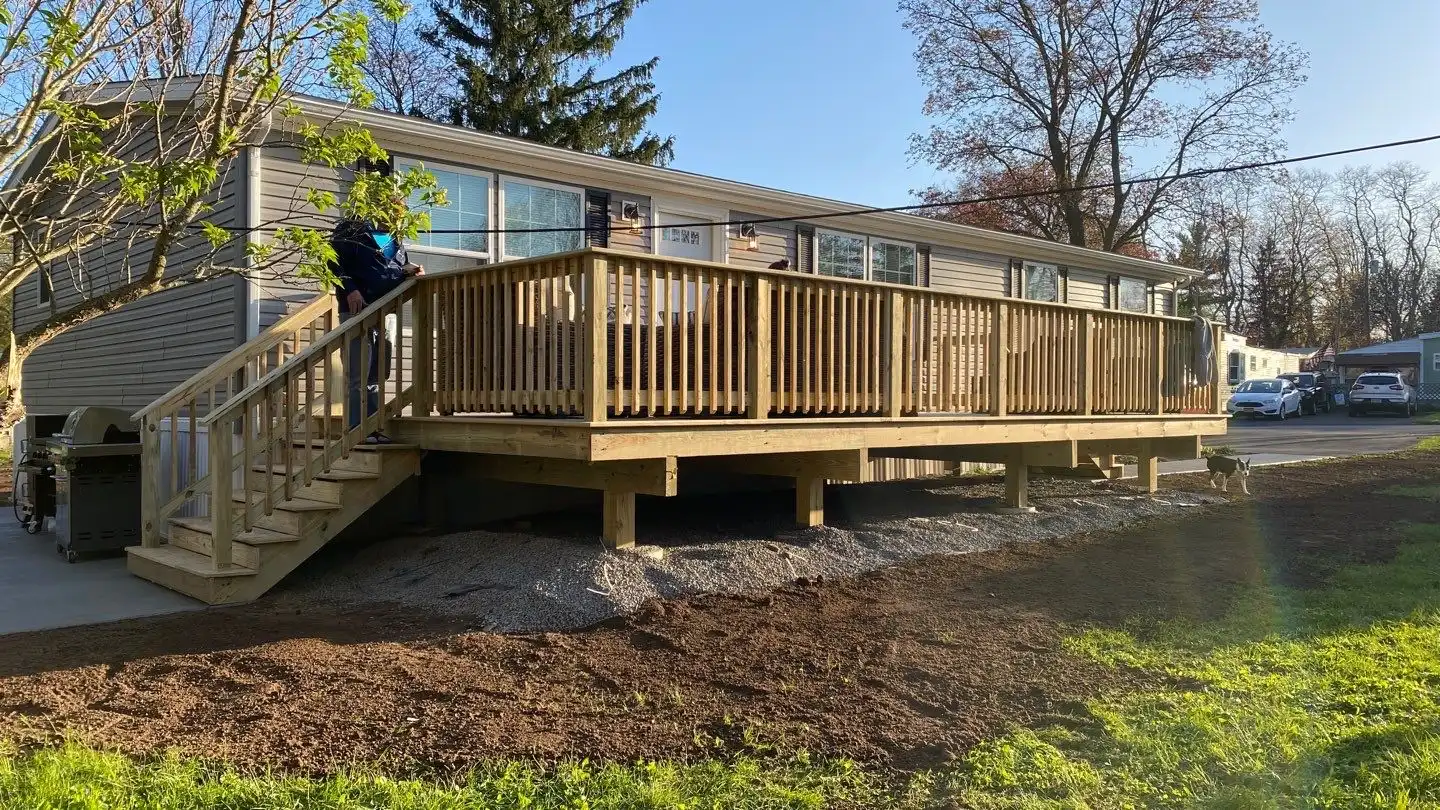
Material Choices: PT and Composite
Two materials cover almost every residential deck we build in Rochester right now. Each has a different price, a different look, a different maintenance ask, and a different lifespan. Neither is wrong; the right one depends on budget, how the deck will get used, and how much weekend maintenance time you want to spend on it.
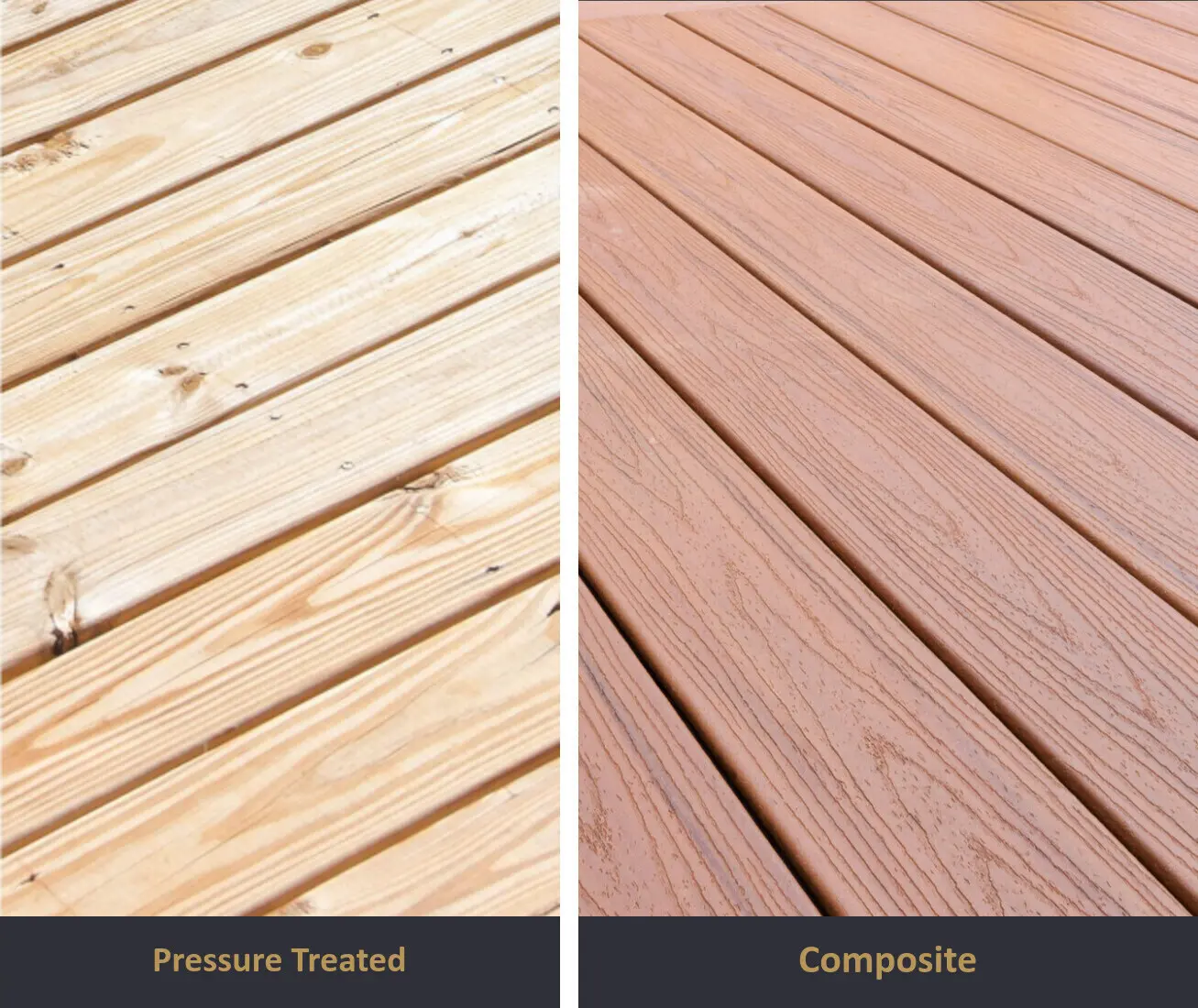
Pressure-Treated Pine
The budget-friendly workhorse. PT pine is the most common deck material in our area for one reason: it costs the least up front and still gives you a real wood deck. The boards arrive with a green or brown tint from the treatment, then weather to a silver-gray over the first year if left alone. Most homeowners stain it within the first 12 to 18 months, which opens up a wide color range from light honey tones through deep walnuts and grays.
Lifespan runs 15 to 25 years with reasonable care. The maintenance ask is real: a re-stain or re-seal every 2 to 4 years to keep moisture out of the grain. Skip that, and the boards check, split, and lose color faster. PT works well for traditional looks, larger decks where material cost matters, and homeowners who do not mind the periodic re-stain weekend.
Composite
Engineered boards made from wood fibers and recycled plastic, capped with a polymer shell. Composite is the fastest-growing deck material in Rochester for one reason: it removes the staining and sealing maintenance entirely. Soap and water cleans it. That is the full maintenance list.
Lifespan runs 25 to 30+ years, and most manufacturers warranty the boards for 25 years against fade and stain. Color range is wide: cool grays, warm grays, multi-tone browns that mimic exotic hardwoods, even reddish tones. Upfront cost is the higher of the two, typically 1.5 to 2x a comparable PT build. Best fit for homeowners who want the deck to look the same in year 15 as it did in year 1, with no weekend maintenance.
Deck Shapes and Layouts
Shape is where the design starts to feel personal. The same square footage can sit on a backyard four different ways, and each layout changes how the space gets used.
Single-level rectangular is the workhorse. Cleanest construction, lowest cost per square foot, easiest to furnish. Works on almost any lot. The risk is that it can feel like one big platform with no zones; furniture placement and railings do most of the heavy lifting to break it up.
Multi-level decks use 6 to 12 inch step-downs to define zones: dining up top, lounge in the middle, fire feature at the bottom. They cost more (additional framing, more rim joists, more railings) but they read as designed rather than placed. Multi-level also handles sloped lots gracefully, where a single-level platform would need long stairs to grade.
Ground-level decks sit within a step or two of the yard. No railings required by code under 30 inches above grade, which opens up clean sightlines and a more patio-like feel. Drainage and ventilation underneath need careful detailing in Rochester so moisture does not get trapped against framing.
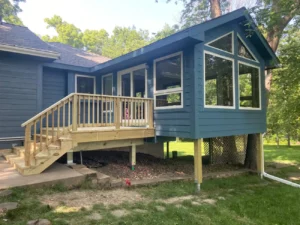
Raised decks sit 4 to 10 feet above grade off second-story doors or sloped lots. Railings are mandatory, stair runs get longer, and the under-deck space becomes a design decision (storage, dry living, or open).
Wraparound and corner decks wrap two or three sides of the house. They work well on corner lots and homes with multiple door access points. Cost scales with linear footage of perimeter, and the framing under transitions needs careful planning.
Freestanding "floating" decks sit fully detached from the house on their own footings. Useful when the house wall cannot take a ledger (stone veneer, EIFS, certain siding conditions) or when the design intent is a destination deck out in the yard rather than an extension of the house. Code still applies; the footings just carry the full load.
Railings: The Choice That Defines the Look
More than any other element, the railing tells you what era the deck was built in. The same deck framing with five different railing systems reads as five different decks.
Wood railings (PT, matched to the decking) are the traditional choice. Lowest cost, fully customizable for baluster spacing and post style. They share the deck's maintenance cycle, which means re-staining the rails every few years along with the boards.
Composite railings match composite decking visually and remove the railing maintenance. They tend to look heavier than aluminum or cable because the structural pieces are larger.
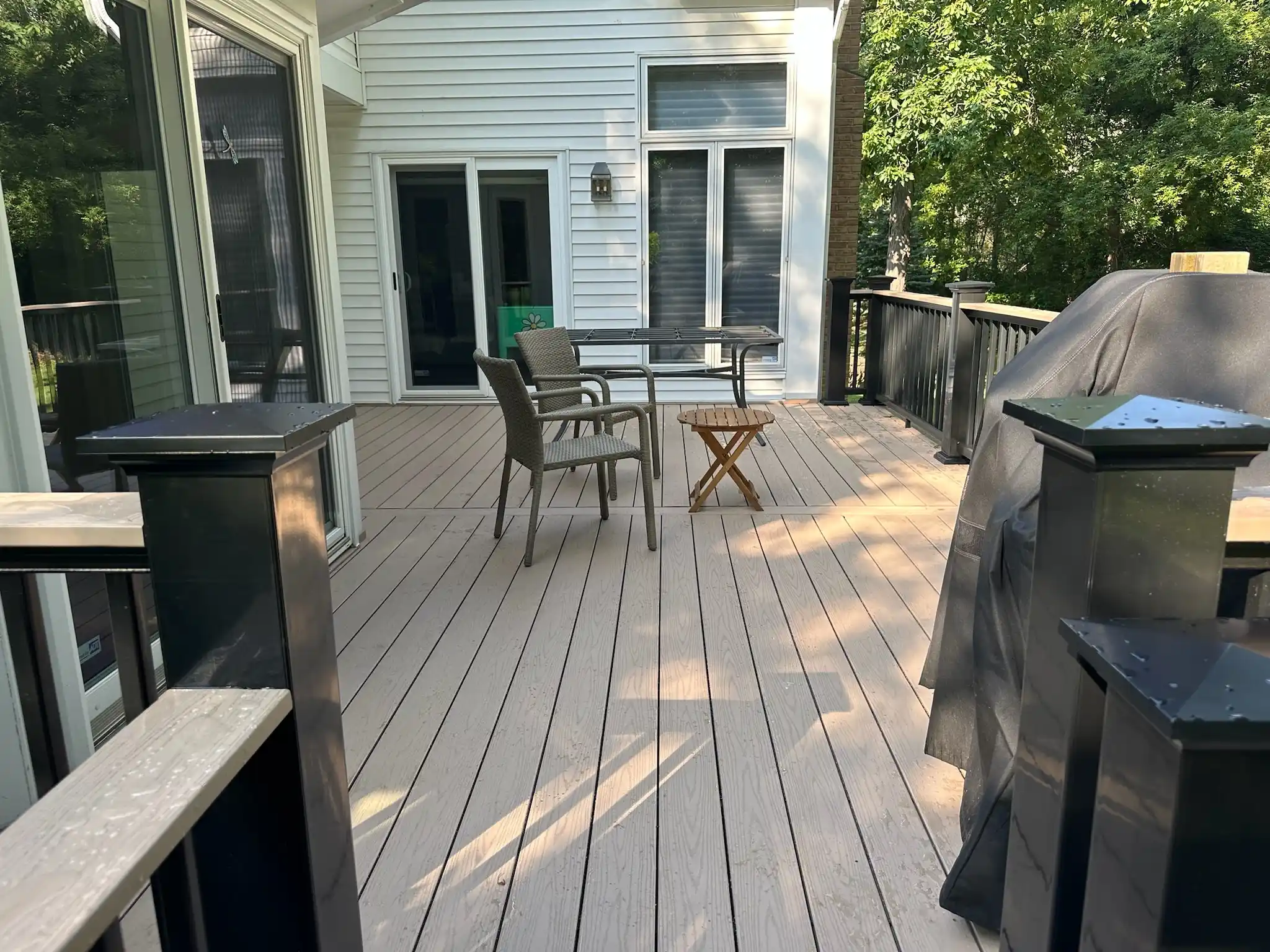
Aluminum railings in powder-coated matte black or dark bronze have surged in popularity in Rochester builds over the past two to three years. The thin profile gives a much more open view than wood or composite, the powder coat holds up against UV and salt, and the look pairs cleanly with both modern composite and traditional wood decking. This is the most-requested railing on NG builds right now.
Cable railings run stainless steel cables horizontally between aluminum or wood posts. They give the most unobstructed view possible without going to glass. Code requires careful tensioning and post spacing so the 4-inch sphere test passes. Higher cost than aluminum, and the cables do need re-tensioning every few years.
Glass railings use tempered glass panels between metal posts. The view is genuinely unobstructed. They are the most expensive option, they show every fingerprint and water spot, and they need regular cleaning to look right. Best fit for decks with a real view worth showing (lakefront, hillside, mature landscaping).
Features That Change How You Use the Deck
A deck with the right built-in features gets used three times as much as one with just a railing and a grill. These are the features worth thinking about during the design phase rather than after, because framing, electrical, gas, and footings all need to be planned in.
Built-in benches and planter boxes double as railing alternatives in code-allowed configurations (where the deck is less than 30 inches above grade), they create defined zones without adding furniture, and they hide structural transitions cleanly. Benches with hinged tops also solve outdoor cushion storage.
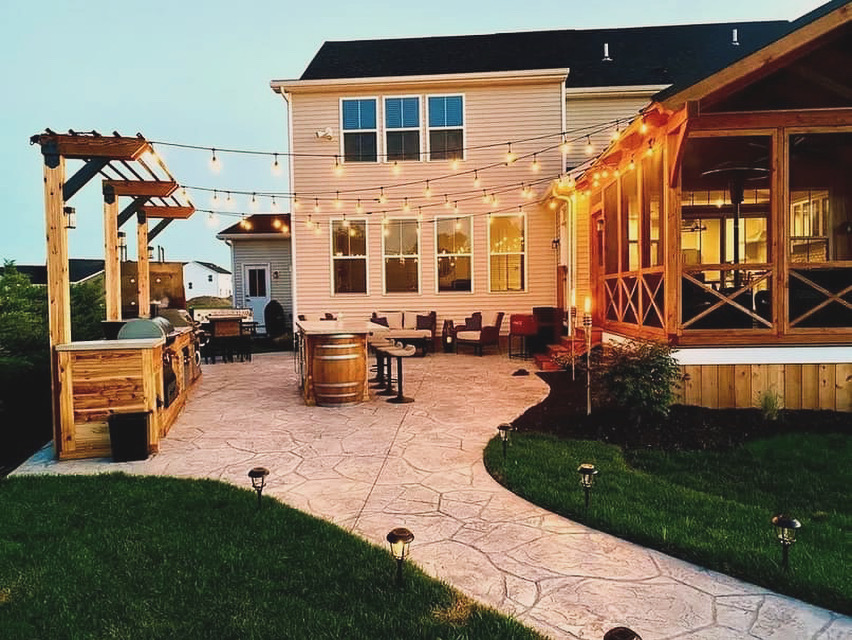
Pergolas (full or partial coverage) extend the usable season noticeably. A partial pergola over the dining zone gives shade in midsummer and breaks rain without closing in the deck. A full pergola or roof extension turns a deck into a three-season space and adds 3 to 4 months of comfortable use in our climate.
Screened sections are increasingly popular for the dining zone specifically: bugs out, breeze in. They require posts and headers planned into the framing from day one, plus a roof or pergola to attach the screen frames to.
Fire features on decks must be gas only in Rochester. Wood-burning fire pits are code-restricted on combustible surfaces (any wood or composite deck) and most local insurance carriers will not cover them either. Gas fire tables, gas fire bowls, and gas fire pits with proper clearance to railings and combustibles are all fair game and look great. Gas line needs to be planned into the framing run.
Outdoor kitchens can be as simple as a built-in grill in a stone surround, or as full as a sink, fridge, side burners, and bar seating. The deck framing under a full kitchen needs to be sized for the load, and water, gas, and electrical all need planning in advance.
Lighting is the cheapest feature that makes the biggest difference. Post-cap lights for general ambiance, riser lights on every stair tread for safety, under-rail strip lights for dining-zone wash. Low-voltage runs are easy to plan during framing; retrofit lighting after the fact is doable but messier.
Hot tub integration requires engineered footings sized for the filled-and-loaded weight (typically 5,000 to 7,000 pounds for a residential 6-person tub). Sinking the tub into the deck frame so the rim sits flush with the deck surface is the cleanest look but commits the deck framing to that specific tub size and location.
Designing for the Rochester Climate
A deck design that looks great in a Phoenix portfolio shot does not always perform here. Rochester adds snow, freeze-thaw, wet shoulder seasons, and big seasonal sun-angle shifts to every design decision. The points below come up on almost every consult.
Snow load. Deck framing in our code zone must carry the engineered ground snow load (40 to 50 psf depending on town). Standard framing handles it; the place it matters most is on cantilevered designs that extend joists past the support beam. Long cantilevers need to be engineered for snow plus live load, not eyeballed.
Covered vs. uncovered. A partial pergola or roof extension over part of the deck adds 3 to 4 months of usable season per year in Rochester. Spring rains and fall chill are the seasons covered space wins back. If outdoor living time matters to you, partial coverage is the single highest-return feature to add.
Sun exposure. South-facing decks get punishing summer afternoon sun from June through August. Plan shade (pergola, umbrella, retractable awning) into the design rather than retrofitting it. North-facing decks stay cool and comfortable in summer but stay wetter longer in spring and fall, and can grow moss on shaded boards; ventilation and surface choice matter more there. East-facing gets morning sun and afternoon shade, generally the most comfortable. West-facing gets harsh late-day sun.
Slip surfaces. Rochester's wet shoulder seasons (March to May, October to early December) turn smooth deck surfaces hazardous. Composite boards with grain texture and pressure-treated wood with a textured stain or matte sealer both give reasonable traction. Smooth-finish composite and high-gloss sealers should be avoided on stairs and traffic paths specifically.
Drainage. Under-deck drainage detailing matters more here than in dry climates. Standing water against ledger boards, post bases, or framing accelerates rot in pressure-treated wood, and traps moisture against composite framing rim joists. Gap spacing between boards (typically 1/8 to 3/16 inch), proper ledger flashing, and either an under-deck drainage system or open ventilation underneath are all worth specifying.
Color and Finish Trends in Rochester Deck Builds
Trends in our market shift on roughly a 5-year cycle, slower than national interior trends but faster than people expect. Here is what has been showing up on NG quotes and competitor builds in the Rochester area over the past two years.
Composite color trends. Cool grays are dominating: Trex "Island Mist," "Pebble Grey," and similar tones from TimberTech and Azek. Warm grays with a slight brown undertone are gaining ground for homeowners who want gray without it reading cold. Multi-tone brown blends that mimic exotic hardwoods are the third major category, popular on traditional and craftsman homes specifically.
PT stain trends. Dark walnut and semi-transparent gray stains have taken over from the old reddish-brown "rancher" tones. Lighter neutrals and weathered-gray tones are increasingly common, often chosen specifically to read more like composite without the composite price tag.
Railing color. Matte black powder-coated aluminum has dominated the past two years and shows no sign of letting up. Dark bronze is the secondary choice. White vinyl and white aluminum, which were standard 10 years ago, have nearly disappeared from new builds.
Common Questions About Deck Design
What's the most popular deck material in Rochester right now?
Composite is the fastest-growing material on NG builds and across the local market, driven mainly by the no-stain, no-seal maintenance profile. Pressure-treated pine is still the most-built material overall because of its lower upfront cost, especially on larger decks where material cost scales fast. The honest split right now is roughly composite and PT trading the top spots depending on budget: composite when low maintenance and lasting color matter most, PT when the upfront cost is the priority.
Should I match my deck to my house siding color or contrast it?
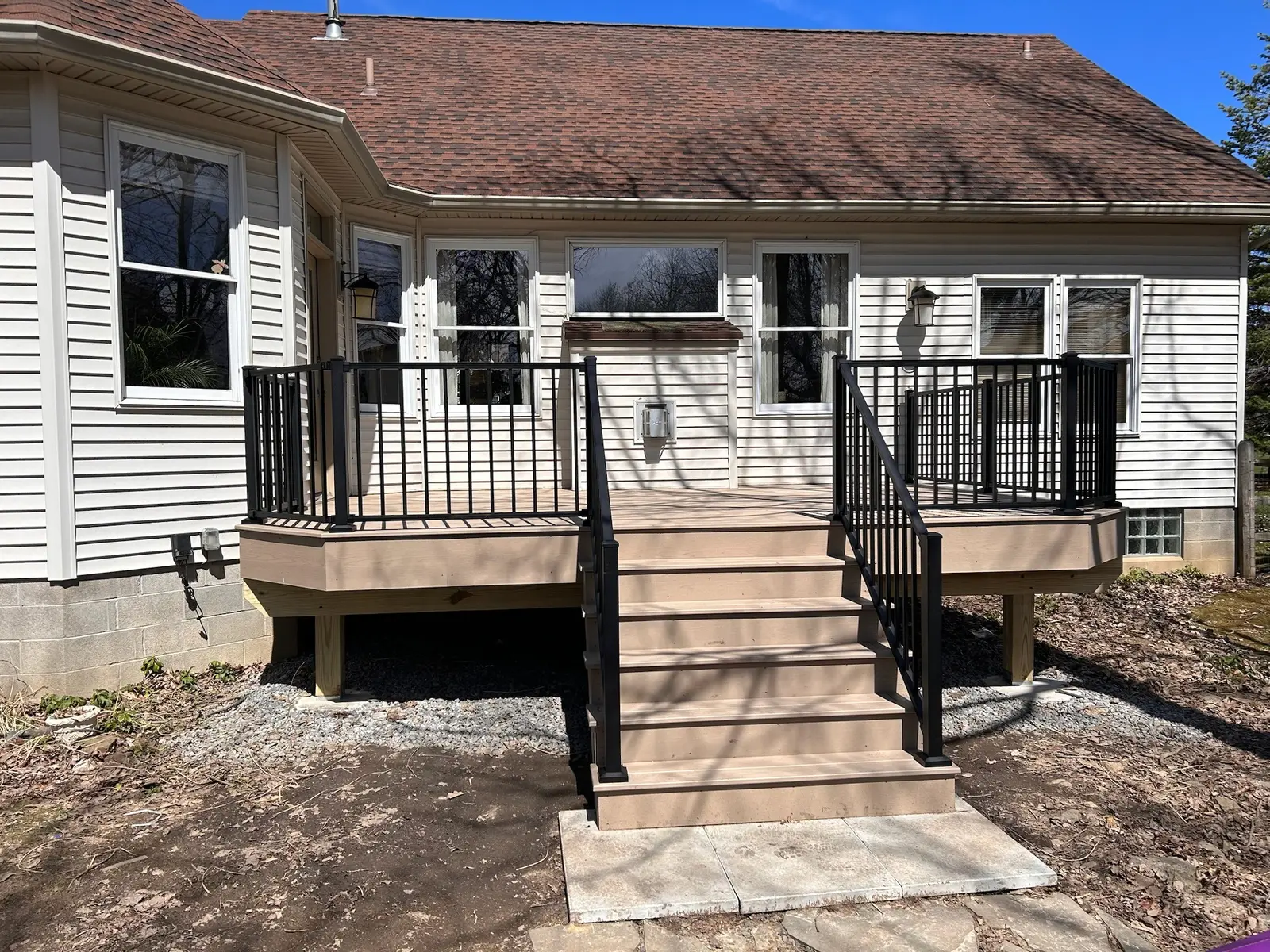
Contrast generally wins in our market, particularly for homes with gray or white siding. A warm-brown composite or stained PT deck against gray siding reads as deliberate. A cool-gray composite deck against warm tan or beige siding reads the same way. Matching siding color exactly tends to make the deck disappear visually, which works on minimalist modern homes but rarely on traditional ones. The railing color is the design lever most homeowners underuse: matte black aluminum on almost any siding color anchors the design.
Can a deck be built over an existing concrete patio?
Yes, with the right framing approach. A low-profile sleeper system (pressure-treated 2x4 or 2x6 sleepers laid on top of the existing patio with proper drainage planes underneath) can carry composite or wood decking directly. The existing concrete provides the substrate; the deck sits an inch or two above it. Height clearance to the door threshold needs to be checked first; many original patios sit too high once you add framing and decking on top. We handle this scenario regularly and walk it during the consult.
How do you design for under-deck use, like covered storage or a dry living area?
Raised decks (typically 7 feet of clearance or more) open up under-deck space as either dry storage or a covered patio zone. To make it dry, you install an under-deck drainage system (Trex RainEscape, Zip-UP, or similar) under the deck boards that catches water through the board gaps and channels it to a gutter at the edge. The space underneath then stays dry through anything but wind-driven sideways rain. Without a drainage system, water passes through the gaps and the area below stays wet whenever the deck is wet.
Have a design in mind? Want help shaping one? Get in touch and we'll walk it. If you are still pricing the project, see our deck cost guide for Rochester or the Rochester deck permit requirements page. Back to the main deck builder in Rochester NY hub.